Data updated October 12, 2026 · All 58 Counties
California Notice of Default (NOD) List
As of October 12, 2026, California has 13,271 notices of default on record across all 58 counties.
A Notice of Default is the recorded document that officially starts a California foreclosure. It's filed with the county recorder after a borrower falls roughly 90 days behind, and it opens a three-month reinstatement window before the lender can schedule an auction. An NOD list is the earliest recorded-document signal that an owner is in trouble — early enough that a sale can still solve their problem.
Search These 17,457 Pre-Foreclosure Properties
7-Day Free Trial · No Credit Card Required · One-Click Sign-In With Google
Sample Records
10 Real Notice Of Default Properties In Los Angeles County
Ten records pulled from the database, picked from the highest AI distress scores in the county. Click a pin or a row to light it up on the map, double-click to open the same property profile subscribers see. Owner names, mailing addresses, parcel numbers, and contacts are shown in the free trial (no credit card required).
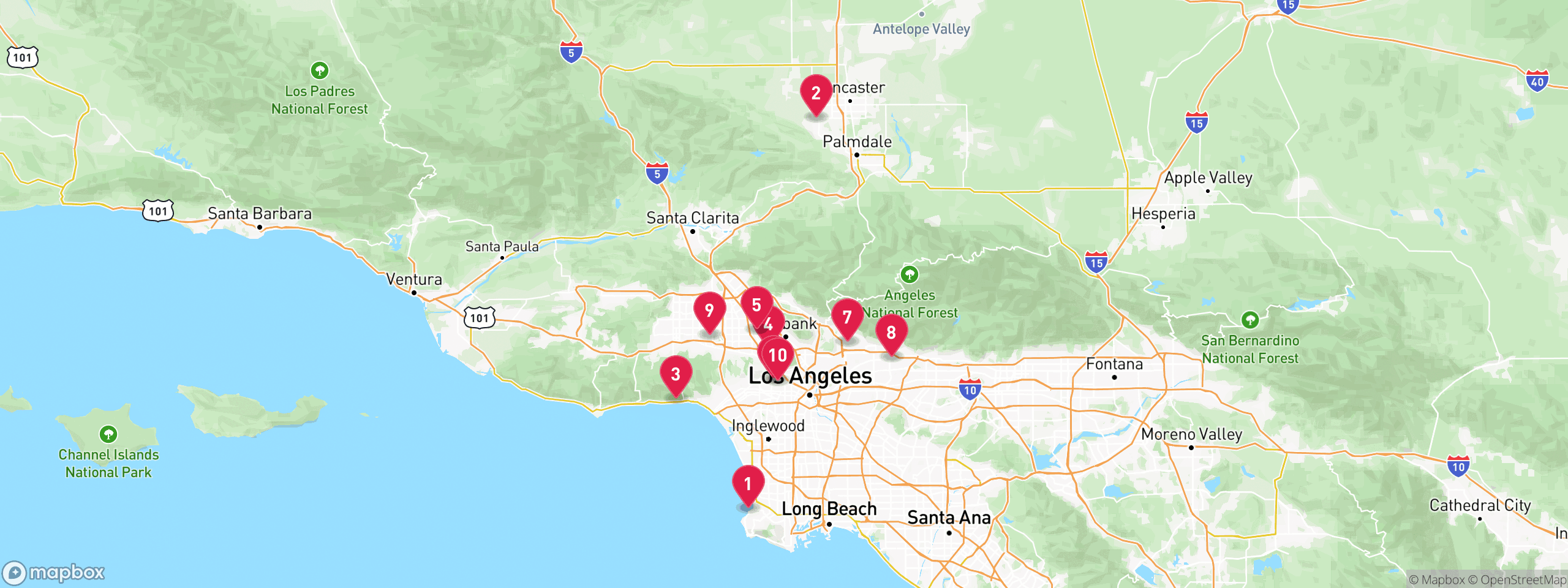
Showing: List. Switch to AI Distress Score to see how our AI ranks these ten by urgency.
| Property | Type | Value | Equity | Default Recorded | Lien Position | Score |
|---|---|---|---|---|---|---|
1605 PASEO DEL MAR PALOS VERDES ESTATES · 6 bd / 7 ba · 6,872 sf | Single Family | $9.68M | $3.97M41% | Aug 4, 2026 Default Recorded | 1st | 85 |
25302 W AVENUE L4 LANCASTER · 6 bd / 3 ba · 2,229 sf | Single Family | $560K | $461K82% | Nov 27, 2024 Default Recorded | 1st | 85 |
319355 PACIFIC COAST HWY MALIBU · 5 bd / 5 ba · 3,683 sf | Fourplex | $1.70M | $487K29% | Jun 11, 2026 Default Recorded | 1st | 78 |
44408 FORMAN AVE TOLUCA LAKE · 3 bd / 2 ba · 2,078 sf | Single Family | $1.89M | $1.52M81% | Sep 19, 2025 Default Recorded | 1st | 77 |
56651 CAMELLIA AVE NORTH HOLLYWOOD · 9 bd / 13 ba · 4,324 sf | Triplex | $1.88M | $641K34% | Aug 10, 2026 Default Recorded | 1st | 77 |
6717 N HIGHLAND AVE STE 12 LOS ANGELES · 1 bd / 3 ba · 1,304 sf | Condo | $1.04M | $169K16% | Mar 26, 2024 Default Recorded | — | 76 |
7374 DOUGLAS ST PASADENA · 4 bd / 2 ba · 1,402 sf | Single Family | $1.30M | $668K51% | Oct 23, 2024 Default Recorded | 1st | 74 |
89 W CAMINO REAL AVE ARCADIA · 4 bd / 5 ba · 3,306 sf | Single Family | $2.46M | $1.50M61% | Oct 14, 2025 Default Recorded | 1st | 74 |
917212 BULLOCK ST ENCINO · 3 bd / 2 ba · 1,470 sf | Single Family | $1.37M | $495K36% | Jul 16, 2026 Default Recorded | 1st | 72 |
10531 N ROSSMORE AVE APT 201 LOS ANGELES · 2 bd / 2 ba · 1,944 sf | Condo | $1.05M | $853K81% | May 28, 2026 Default Recorded | 1st | 72 |
Want all 13,271 notices of default across California?
These ten are the sample. Owner names, mailing addresses, parcel numbers, lenders, trustees, one-click skip tracing, and direct mail are shown in the free trial (no credit card required).
The Profile
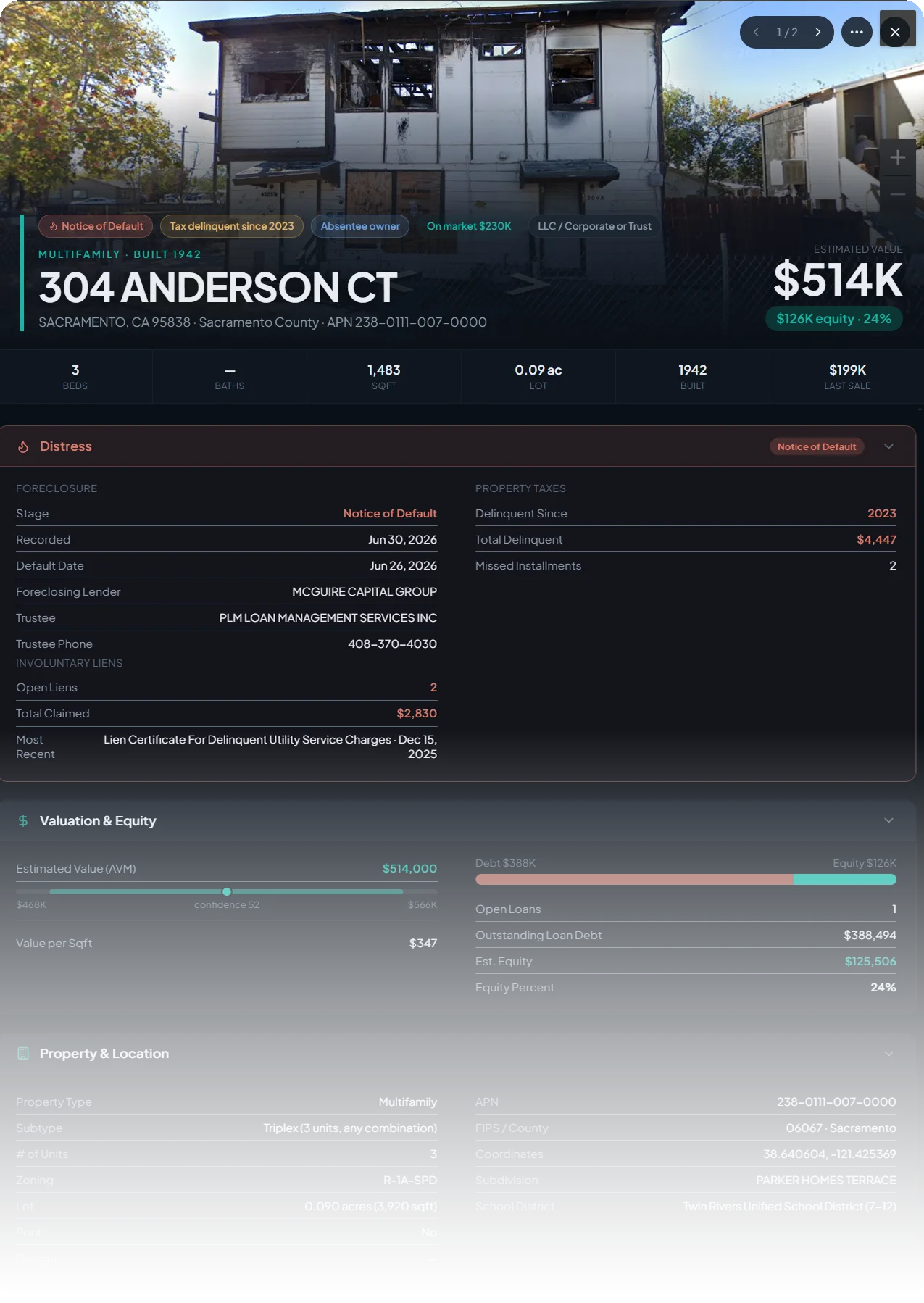
One click. The whole picture.
The full foreclosure pipeline
Every notice of default and trustee sale, statewide. Auction date, time, location, opening bid, and the trustee's phone number.
True equity
Valuation minus every open loan on record, estimated balances included. Filter for the equity range your strategy needs.
How California's Numbers Are Moving
Change over the past week (since October 6), from Properant's daily snapshots of recorded county documents. The series grows every day.
California Foreclosure Filings By Month
Notices of default and trustee-sale notices recorded across all 58 California counties over the last 12 months, counted from the recorded documents. Over that period the state recorded 35,561 notices of default and 19,541 sale notices; March 2026 was the busiest month with 5,421 filings. Default filings over the last three months are down 7% against the three before, and sale notices are down 4%. October 2026 so far: 75 defaults and 110 sale notices.
| Month | Notices Of Default | Sale Notices |
|---|---|---|
| September 2026 | 2,515 | 1,464 |
| August 2026 | 2,797 | 1,535 |
| July 2026 | 3,087 | 1,941 |
| June 2026 | 3,048 | 2,227 |
| May 2026 | 2,828 | 1,460 |
| April 2026 | 3,203 | 1,434 |
| March 2026 | 3,818 | 1,603 |
| February 2026 | 2,737 | 1,438 |
| January 2026 | 2,745 | 1,716 |
| December 2025 | 2,909 | 1,673 |
| November 2025 | 2,226 | 1,384 |
| October 2025 | 3,648 | 1,666 |
Recorded filings by recording month; the month in progress is shown in the text above, not the table. A filing is counted when it records, whether or not it is later cured or cancelled.
What's on Every Property Record
Each NOD on the list carries its recording date, the past-due amount from the filing, the foreclosing lender and trustee, the owner's record and mailing address, every open loan on the property, and its true equity position — so you can separate owners with room to sell from owners who are underwater before you spend a stamp.
The California Notice Of Default Timeline
The clock on a California foreclosure is set by statute, and every date on it is public. A lender can record a Notice of Default once a borrower is roughly 90 days behind. Recording it opens a reinstatement window of three months in which the owner can bring the loan current — penalties and fees included — and stop everything. Only after that window can the lender record a Notice of Trustee Sale, which sets a public auction at least 21 days out. Add it up and an owner who just received an NOD is typically four months or more from losing the home, and most are further: sales get postponed, loans get modified, houses get sold. For outreach, the recording date on each NOD is the whole game — it tells you exactly where the owner stands on that clock, and this list carries it on every filing.
How To Read A Notice Of Default Filing
An NOD names the trustee handling the foreclosure, the beneficiary (the foreclosing lender), the loan in default, and — in the statutory declaration — the amount past due. That past-due figure is the sharpest number in distress data: it separates an owner three payments behind from an owner three years behind on an otherwise similar home. On this list, every filing is matched to its parcel and shown with the owner of record and mailing address, every open loan against the property (not just the one in default), other recorded liens, and a true equity estimate — which is how you tell an owner with room to sell from an owner who is underwater before you write a single letter.
Getting The Notice Of Default List By County
County recorders don't publish a running NOD list — filings sit in the recorder's index one document at a time, mixed with rescissions and reinstatements that quietly cancel earlier notices. This page assembles the recordings into an actual list, statewide, with cures and cancellations removed. Every county has its own page: Los Angeles County alone carries the state's largest notice-of-default count, and the county pages below break the list out for all 58 — each with its own live count, city breakdown, and the owner records behind the filings.
Los Angeles County Notice Of Default List →Frequently Asked Questions
How many notices of default are there in California?
Properant tracks 13,271 notices of default across California's 58 counties as of October 12, 2026, counted from recorded county documents with releases and cancellations removed.
How current is the notice of default list?
Filings are processed as county recordings are ingested, and properties leave the list when a cure, cancellation, or sale is recorded. A notice of default that was reinstated last month is not on this list.
Can I download the notice of default (nod) list?
Yes. Inside Properant you can filter by county, city, equity, owner type, and every other signal, save the list, and export it — or upload your own list and let the platform match and enrich it. The trial is free and requires no credit card.
Build Your Notice of Default (NOD) List in Minutes
This page is one slice of it. Properant connects every parcel in California to its owner, open loans, liens and foreclosure stage — then scores and skip-traces the ones worth calling.
Want to search these 17,457 pre-foreclosure properties?
Explore the live California pre-foreclosure database in Properant.
See the Live List→7-Day Free Trial · No Credit Card Required
Top California Counties
| # | County | Count | Share of Statewide |
|---|---|---|---|
| 1 | Los Angeles County | 3,007 | 22.7% |
| 2 | Riverside County | 1,267 | 9.5% |
| 3 | San Bernardino County | 1,078 | 8.1% |
| 4 | San Diego County | 750 | 5.7% |
| 5 | Kern County | 713 | 5.4% |
| 6 | Sacramento County | 596 | 4.5% |
| 7 | Fresno County | 500 | 3.8% |
| 8 | Orange County | 476 | 3.6% |
| 9 | Contra Costa County | 377 | 2.8% |
| 10 | Alameda County | 356 | 2.7% |
| 11 | San Joaquin County | 325 | 2.4% |
| 12 | Santa Clara County | 308 | 2.3% |
| 13 | Stanislaus County | 274 | 2.1% |
| 14 | Tulare County | 248 | 1.9% |
| 15 | Solano County | 240 | 1.8% |